
Exclusive Insights · Training What is zone 2 training good for?
Slow down to speed up: why easy training makes you fitter and faster.
The short answer
Zone 2 training is easy endurance training at a pace where you can still talk in full sentences, roughly 60 to 70% of your maximum heart rate. It builds your aerobic base: your heart gets stronger, your muscles use oxygen and fat more efficiently and you recover faster. The result: you can hold a higher pace for longer. That is why most endurance athletes do the bulk of their training at an easy intensity.
Do you always go all out? Every session sweaty, out of breath and wiped out on the way home? It feels good, but it might be holding back your progress. Improving your fitness does not mean every session has to be hard. Sometimes you have to slow down to get faster.
What is zone 2 training?
You can split your heart rate into five zones. The higher the zone, the harder the effort. Zone 2 is the second zone: easy enough to keep talking, but hard enough that you notice you are training.
| Zone | % max. heart rate | How it feels | Used for |
|---|---|---|---|
| Zone 1 | 50 to 60% | Very easy, talking is effortless | Recovery, warm-up |
| Zone 2 | 60 to 70% | Easy, you can still talk in full sentences | Building your aerobic base |
| Zone 3 | 70 to 80% | Steady, talking in short sentences | Tempo, but also the trap |
| Zone 4 | 80 to 90% | Hard, only a few words | Your pace at race speed |
| Zone 5 | 90 to 100% | Maximal, talking is no longer possible | Short, explosive intervals |
The percentages are a guide. Everyone is different, and the fitter you are, the better zone 2 matches how it feels.
What is zone 2 training good for?
In zone 2 your body gets most of its energy from oxygen. That system is your aerobic base, the engine underneath all your other training. By working on it deliberately, this happens:
- Your heart gets stronger. It pumps more blood per beat, so your heart rate drops at the same pace.
- Your muscles get more efficient. They develop more small blood vessels and more mitochondria, the power plants in your muscle cells.
- You burn fat better. Your body learns to use fat as fuel and saves your carbohydrates for the hard parts.
- You clear lactate better. So you fatigue less quickly at a higher pace.
- You recover faster. Between hard efforts, and from one session to the next.
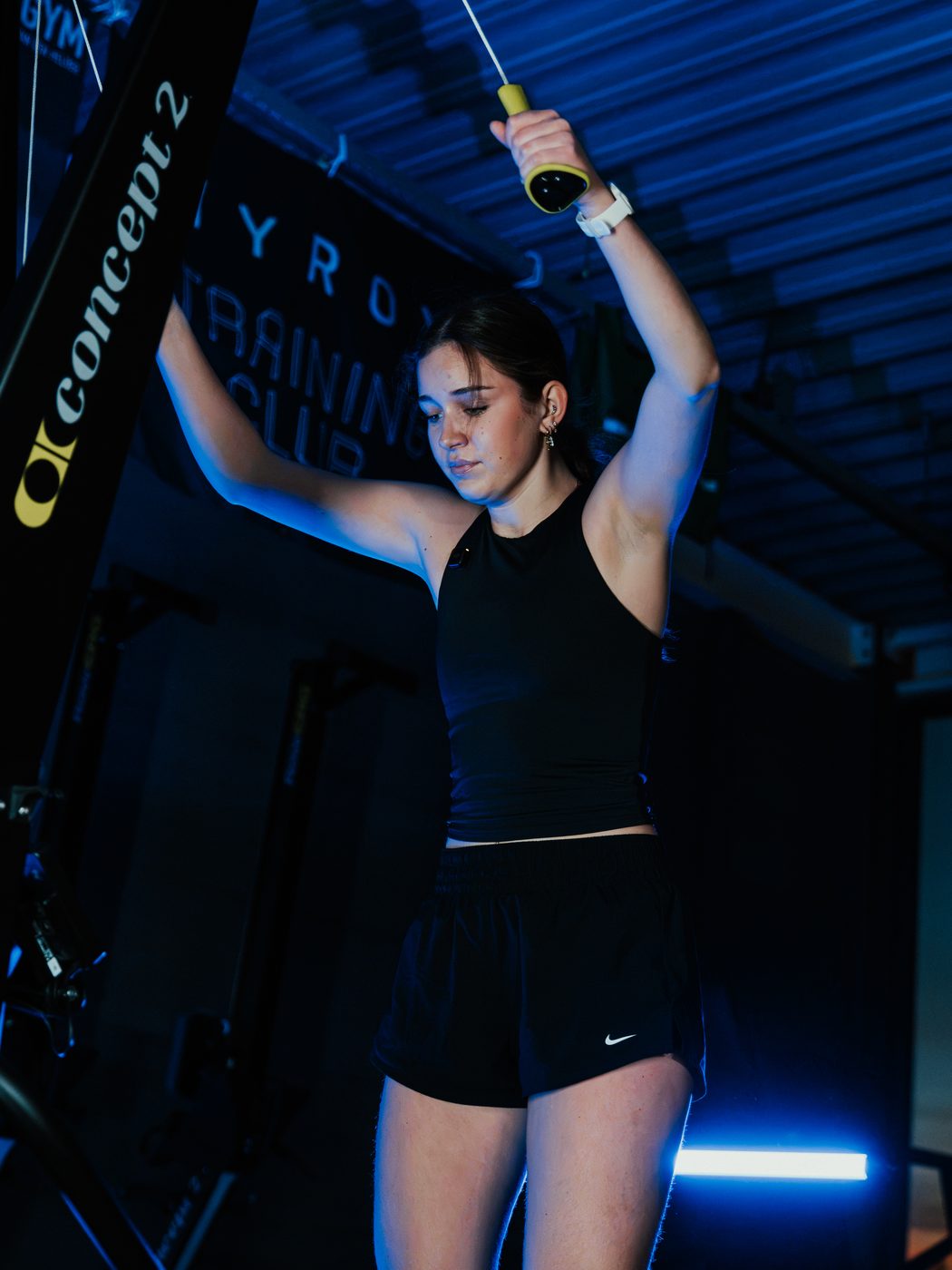
You notice the effect everywhere: when running, on the SkiErg and at your next HYROX.
Why does zone 2 feel so slow?
Because it is easy. And that is exactly where it often goes wrong. Many people train “easy” just a little too hard and end up in zone 3. That feels productive, but you are too tired to really improve from it and it is too hard to recover from properly. You are in the grey zone: not easy enough for your base, not hard enough for your speed.
Do you have to walk instead of run to stay in zone 2? That is normal when your base is still small. It changes, and often faster than you think.
How do you calculate your zone 2 heart rate?
There are a few ways. The more accurate, the better your training fits.
1. The talk test
Can you still talk in full sentences without gasping for air? Then you are in the right place. Only a few words? Then you are going too hard. Simple and surprisingly reliable.
2. Calculating with your maximum heart rate
A common estimate is 220 minus your age. If you are 35, your maximum heart rate is about 185 and zone 2 is around 111 to 130 beats per minute. Note: this is a rough estimate. For some people it is off by 10 to 15 beats.
3. A test
The most accurate option is an exercise test or a supervised field test. Then you know exactly where your limits are instead of an average.
Training with a sports watch? A chest strap measures more accurately than a watch on your wrist, especially in exercises where you use your arms a lot, such as the SkiErg and the rower.
How often should you train zone 2?
That depends on your goal.
- Want to stay nicely active? Then include one zone 2 session a week in your schedule.
- Want to really improve your aerobic base and eventually get faster? Then we recommend training in zone 2 at least twice a week.
- Be patient. After 6 to 8 weeks you will usually notice you can hold the same pace at a lower heart rate.
For comparison: many endurance athletes do about 80% of their training easy and 20% hard.
A zone 2 session to get started
Easy does not have to be boring. Switch machines and keep your heart rate in zone 2 the whole time:
- 8 minutes SkiErg
- 8 minutes rower
- 8 minutes bike or treadmill
- 2 minutes easy walking between blocks
Then build it up gradually. Add a few minutes per block each week, until you can eventually work for 20 minutes at one steady pace. The goal is not to cover as many metres as possible, but to stay in zone 2 for the whole session. Heart rate too high? Then ease off.
What does zone 2 training do for HYROX?
For most people a HYROX takes between 60 and 100 minutes. That is mainly an endurance effort. You run 8 kilometres and after every station you have to keep going. With a strong aerobic base your heart rate recovers faster after the sled push or the wall balls, and you can keep running your kilometres at a steady pace. That is why zone 2 is part of every good HYROX plan.
Common mistakes
- Still going too hard. Your ego wants to go faster, but your heart rate sets the pace.
- Only doing intervals. Hard sessions stay important, but without a base you get less out of them.
- Giving up too soon. The effect builds over weeks, not days.
- Blindly trusting your watch. Combine your heart rate with the talk test.
Coach's tip
Do the talk test out loud. Train with someone and keep chatting the whole session. Can you no longer manage it? Then you are going too hard. You quickly learn how zone 2 feels, even without a watch.
When should you look at your heart rate differently?
Taking medication that affects your heart rate, such as beta blockers? Then the standard zones do not apply and you are better off training by feel and the talk test. Have heart problems, or do you feel dizzy or short of breath while exercising? Then see your GP first.
How we do it at Exclusive Gym
As an official HYROX Training Club, we train both your engine and your speed. Together we determine your heart rate zones and build a plan in which easy and hard sessions reinforce each other. In the gym or online. Read more about HYROX training, personal training or online coaching.
Tailored training
Slow down to speed up
Want to know which zones you should train in? Book an intake via WhatsApp.
Keep reading